on the cross

I don’t know about you, but this is often the only thing that comes to mind when someone asks about the cross:

Why did Jesus die for me? Because he loves me.

True, but equally true and arguably more important is this:

Why did Jesus die for me? Because I was bad and I deserved to die on that cross, not him.

We – all who trust in Jesus’ promise that the cross has set us free from death – are all alike. We are the sinful firstborn of Abraham who was spared sacrificial death because God promised that the death of a lamb instead would suffice. We are the firstborn of faithless Israel in Egypt, spared fatal judgement because a firstborn passover lamb took our place. We are the convict Yeshua bar-Abbas, the sinful son of the father, spared from execution at the last minute because the firstborn son of the father who shares our name, Yeshua bar-Joseph, went to the cross in our place.

on japan’s treatment of its christians

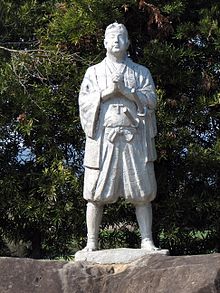
Meet Amakusa Shiro, the charismatic teenaged leader of the ill-fated Shimabara rebellion in Japan, which began in 1637 and was put down a year later.

What started off as general discontent among the commoners of Shimabara against their heavy-handed masters culminated in the lynching of a local tax official. As the revolt gathered steam the rebels attempted to storm the local lord’s castle, but were repelled. As government troops arrived on the scene the rebels, under Shiro, captured the previously abandoned Hara castle and prepared to make their last stand there. Continue reading “on japan’s treatment of its christians”

on friendship and brotherhood

Brotherhood, camaraderie and friendship are important values to me. So today during a business meeting I thought about the different attitudes to friendship and brotherhood I’ve encountered:

Jesus takes a very counter-cultural attitude to friendship – it can be a hindrance to following Jesus (Luke 14:26). Brotherhood is not determined by blood, or shared experience, whether hardship or pleasure; rather is it determined by a shared purpose in doing the will of God (Mat 12:48-50). There is however also something sacred in brotherhood, to love and care for one’s brothers is to do the same for Jesus (Mat 25:40). Jesus defines love as laying down one’s life for friends, while at the same time calling his friends to do the same for each other, and in so doing, become closer to Jesus (John 15:13-15). And finally Jesus insists that his followers should not love only their friends, but should show sacrificial love to enemies as well (Mat 5:43-48). Continue reading “on friendship and brotherhood”

on re-writing the past

‘The winners write the history books’ may be a cliché but it is pretty true, come to think of it.

I’d been reading In the Shadow of the Sword by Tom Holland not too long ago, and his look at the historicity of the Koran was pretty new to me. In Islam, the Koran is supplemented to a large extent by the hadiths, which are sayings attributed to Muhammad and for that reason carry a lot of authority. Hadiths can be taken alone or can be used to interpret the Koran.

Holland argues however that for all the vicarious authority the hadiths carry, very few of them can concretely be traced to Muhammad, which to my mind raises questions about their historicity (and validity) to begin with.

Which got me thinking – most cultures in this world will fudge with history if they think they can get away with it, and/or if it suits them. Continue reading “on re-writing the past”

on the ending to gladiator

Quick post: anyone notice the ending to the film Gladiator and its vaguely gospel message? Nevermind the Christ parallels with Maximus in the last few scenes – dangling cross-like from chains (something mentioned in the DVD commentary), stabbed in the side, died to free his men, etc. – that’s just playing around with religious imagery.

But did you notice Juba’s parting words at the very end of the film?

He says to Maximus, now in the afterlife, whose death has saved Juba from execution, “Now we are free. I will see you again, but not yet… Not yet.” He then leaves the place of death and slavery to live his life as a free man.

That is, in a nutshell, the gospel message.

Probably a coincidence, but it would be awesome if the script writer had actually been trying something there.

on organisation and self-righteousness

I’m what you’d call a regimented and organised person. A control freak, even.

I like things to be in order, possibly for this reason the military is an area of interest to me. I am a creature of habit. I don’t like surprises, and kids don’t often find me fun. Friends and family can find me cloying at best and controlling at worst.

On the plus side it makes me a very responsible person, very meticulous, and it also makes my desk one of the tidiest and best organised in the office. Continue reading “on organisation and self-righteousness”

on comparing jesus to lots of things

Jesus, you are warm, warm like sunshine on the grass at the park, warm like a nice coat on a cold morning.

You are playful, like a light drizzle in the winter, like the birdsong in the middle of the night, like a little kid taking his first steps.

You are sustaining, like a packet of biscuits on a very empty stomach.

You are gentle, like the older brothers who sit me down and listen.

You are dashing, like a warrior marching to battle.

You are soft, like the breeze on my face.

You are fierce, like a bear defending her cubs.

You are constant, like the smooth surface of the third pillar from the right at the entrance to All Souls Church Langham Place.

You are just, like the constant sunrise.

You’ll come back, like you said you would.

on self worth

Satan will tell you that your worth lies in how many zeroes your pay check ends in, or how many women you’ve held in your arms, or how many square feet your house contains.

If he’s feeling clever he will tell you your worth lies in how much time you spend with your family, or how many lives you’ve touched, or how many hours you spend helping other people. Continue reading “on self worth”

Blog at WordPress.com.

Up ↑